
Everything pharmaceutical manufacturers, compounding pharmacies, and packaging managers need to know before investing in induction cap sealing equipment — from how it works to which machine to buy.
What Is an Induction Sealing Machine?
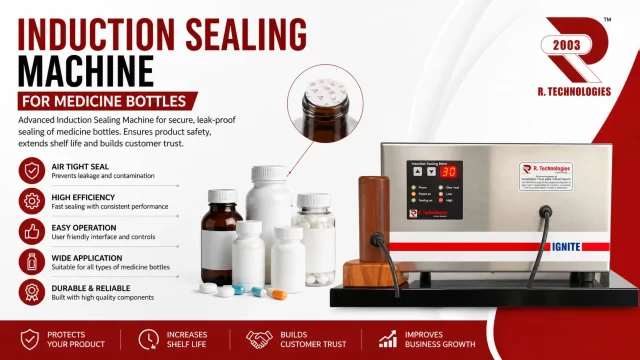
An induction sealing machine uses electromagnetic induction to bond a foil liner inside a bottle cap to the mouth of the container — without direct contact. The result is an airtight, tamper-evident seal that protects product integrity, extends shelf life, and satisfies regulatory requirements across pharmaceutical, nutraceutical, and healthcare markets.
For medicine bottles specifically, induction sealing is often mandatory under GMP and regulatory frameworks such as the US FDA 21 CFR, EU GMP Annex 15, and Schedule M in India — making the right machine a compliance investment, not just a production one.
How Does Induction Sealing Work?
The induction sealing process follows four steps. A cap with a multi-layer foil liner (typically aluminium + polymer heat seal layer) is applied to the bottle. The capped bottle passes under an induction coil. High-frequency electromagnetic energy heats the aluminium layer. The polymer layer melts and bonds permanently to the bottle lip — forming a hermetic seal in under a second.
No heat, steam, or adhesive contacts the product directly, which is critical for pharmaceutical applications where contamination risks must be zero.
Types of Induction Sealing Machines for Medicine Bottles
Handheld Induction Sealer
Best for small-batch compounding pharmacies, R&D labs, and startups. Low capital cost (₹15,000–₹80,000). Portable, no conveyor needed.
Tabletop / Benchtop Sealer
Ideal for medium-volume lines (500–3,000 bottles/hr). Operator places bottle under fixed head. Popular in mid-size pharmaceutical units.
Inline Conveyor Sealer
For high-speed production lines. Integrates with filling and capping machines. Output: 50–300+ bottles/min. GMP-grade stainless construction.
Continuous Tunnel Sealer
Bottles flow continuously on a belt under the sealing head. Best for uniform, round bottles. Maximum throughput with minimal downtime.
Key Features to Look for When Buying
1. Power output and frequency control
Look for machines with adjustable power (500W–5kW range for pharmaceutical lines) and digital frequency control. This lets you fine-tune seal quality across different cap diameters (from 20mm to 120mm) and foil liner thicknesses without changing the sealing head.
2. Sealing head design
A flat spiral coil suits most standard round-neck medicine bottles. Machines with interchangeable heads offer flexibility across HDPE, PET, glass, and PP bottles — essential if you run multiple product formats.
3. GMP-compliant construction
For pharmaceutical environments, the machine body, conveyor, and contact parts must be 316L stainless steel, with IP-rated enclosures and smooth, cleanable surfaces. Verify compliance certificates before purchasing.
4. Speed and integration capability
Match the machine speed to your filling line output. Ensure the sealer offers PLC control with industry-standard communication protocols (RS-232, Ethernet/IP) for integration into your existing SCADA or line management system.
5. Seal verification system
Advanced machines include integrated vision systems or capacitive sensors that detect failed seals in real time, rejecting non-conforming bottles automatically — a critical feature for regulated pharmaceutical environments.
Compatible Bottle and Cap Materials
- HDPE medicine bottles (most common for tablets, capsules, powders)
- PET / PETG bottles (syrups, liquid oral dosage forms)
- PP (polypropylene) containers
- Glass pharmaceutical bottles with plastic caps
- Child-resistant (CR) caps with induction liner
- Snap-top and flip-top caps with pre-applied foil liners
Induction sealing does not work on metal caps, caps without foil liners, or containers made of metal or metallic composites. Always confirm cap-liner compatibility with your supplier before purchase.
Pharmaceutical Regulatory Compliance
For medicine bottle sealing, the machine and process must align with applicable regulations. In India, Schedule M (GMP) under the Drugs and Cosmetics Act mandates tamper-evident packaging for all oral solid dosage forms. In the US, the FDA requires tamper-evident packaging under 21 CFR Part 211.132. EU pharmaceutical manufacturers follow GMP Annex 1 for sterile products and Annex 15 for validation requirements.
When purchasing, request IQ/OQ/PQ documentation support from the manufacturer — this is essential for regulated pharmaceutical plants undergoing audits.
Induction Sealer Price Guide (India, 2025)
Entry Level
Handheld / Manual
₹15,000 – ₹80,000. Suitable for compounding pharmacies and small batches. No conveyor.
Mid Range
Semi-Automatic Benchtop
₹80,000 – ₹3,50,000. For growing pharmaceutical units. Adjustable power, digital controls.
Industrial
Fully Automatic Inline
₹3,50,000 – ₹15,00,000+. GMP-grade, PLC-controlled. For licensed pharmaceutical manufacturers.
Prices vary by brand, output speed, CE/GMP certification, and after-sales support terms. Import duties and GST apply on imported machines.
Top Applications in Pharma & Healthcare
- Tablet and capsule HDPE bottles (Rx and OTC)
- Syrup and suspension PET bottles
- Nutraceutical and supplement containers
- Veterinary medicine bottles
- Diagnostic reagent vials and bottles
- Herbal and Ayurvedic formulation containers
- Hospital and institutional bulk packs