
Table of Contents
- Induction Cap Sealing Machine: Working Principle, Price & India Manufacturers
- How an Induction Cap Sealing Machine Actually Works
- Manual vs. Automatic: The Practical Trade-off
- Industry Applications Across India
- How to Choose the Right Induction Sealing Machine: 5 Questions to Ask
- Frequently Asked Questions
Walk into any pharmaceutical plant or juice bottling facility in India, and you’ll find one machine doing quiet, critical work: the induction cap sealing machine. It creates the tamper-evident foil seal under the cap that consumers trust — and regulators require. Yet for many procurement teams and plant managers, choosing the right machine remains surprisingly confusing.
This guide cuts through the noise. We’ll explain exactly how induction sealing works, break down real pricing for the Indian market, compare manual versus automatic options, and help you identify which machine type fits your production line and budget.
How an Induction Cap Sealing Machine Actually Works
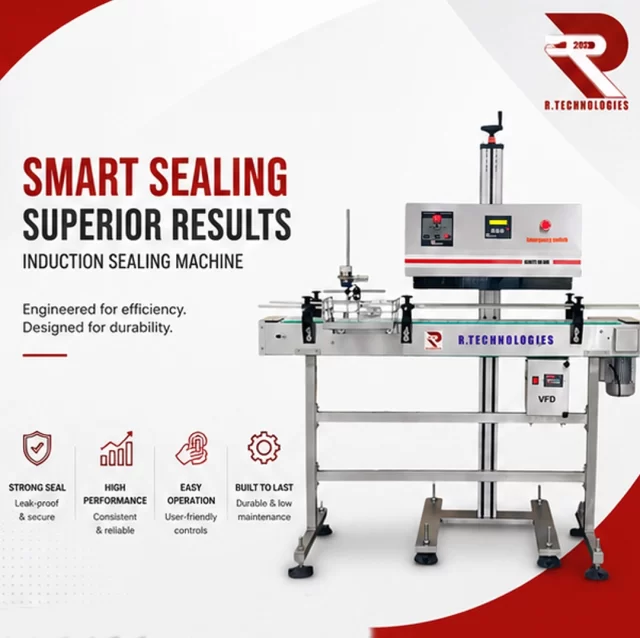 The working principle of an induction cap sealing machine is elegant in its simplicity — and that’s precisely why it’s trusted across high-stakes industries like pharmaceuticals and nutraceuticals.
Here’s the core mechanism: the machine generates a high-frequency electromagnetic field. When a bottle capped with an aluminium foil liner passes through this field, eddy currents are induced in the foil. These currents generate localised heat — enough to melt the wax and polymer layers of the liner and bond the foil hermetically to the bottle mouth. The cap itself is never heated.
Types of Induction Cap Sealing Machines: Which One Do You Need?
The most important thing when buying an induction cap sealing machine? Make sure the type matches your production volume and bottle format. That’s really where it all starts. In India, you’ll usually find three main options:
Manual / Handheld 🖐️
Here, the operator holds the sealing head over each bottle, one at a time. This setup works best if you’re doing small batches—think R&D, startups, or those running cottage-scale food businesses. It won’t break the bank, it’s pretty flexible, and you don’t need a conveyor system at all.
Automatic with Conveyor 🏭
With this one, bottles move along a motorised belt and pass under the sealing head on their own. If you’re moving up to mid or high-volume production—like in pharma, dairy, or packaged drinks—this is the way to go. You get fast, repeatable, and reliable seals without slowing down your line.
Air-Cooled Models ❄️
When you need to keep things running around the clock, air-cooled machines handle the heat. They have built-in cooling that stops the machine from overheating, even during nonstop, high-speed production. Big pharma companies and FMCG plants rely on these for their sheer stamina.
Induction Foil Capping 🧴
This type is specially made for plastic bottle necks. If you’re packaging health supplements, lubricants, or any liquid FMCG products where the cap seal can’t fail, you’ll see these machines everywhere. Integrity matters, and that’s what these deliver.
Manual vs. Automatic: The Practical Trade-off
Manual plastic bottle cap sealing machines are a pragmatic first step for businesses just entering the packaged goods space. They require no conveyor integration, no line reconfiguration, and the capital expenditure is minimal — often under ₹20,000 for basic models. The trade-off is throughput: a human operator can reliably seal perhaps 200–400 bottles per hour, with seal consistency varying by operator skill and fatigue.
Automatic induction sealing machines with conveyors eliminate operator dependency. Seal quality is governed entirely by machine parameters — power level, belt speed, and gap distance — which can be precisely calibrated and locked. For any GMP-compliant facility, this repeatability isn’t a luxury, it’s a regulatory necessity.
Buyer’s Note
These are indicative ranges. The actual induction cap sealing machine price depends on bottle diameter range, conveyor length, PLC integration, and after-sales support terms. Always request a site-specific quotation from manufacturers before comparing.
Industry Applications Across India
Induction sealing isn’t just for one industry—it’s everywhere you look. Any sector that bottles liquids or semi-solids relies on it.
Pharmaceuticals: This field pushes the limits. Regulatory bodies, like those enforcing Schedule M under the Drugs and Cosmetics Act, expect tamper-evidence on anything from oral liquids to syrups and supplements. Air-cooled automatic machines are pretty much the go-to for that.
Food & Beverages: Think honey, edible oils, sauces, juices—the list goes on. Induction sealing locks in freshness and keeps flavors true, and you don’t need refrigeration. It also helps companies avoid all those annoying product returns from leaky packaging.
Dairy: For products like flavored milk, curd, and ghee, conveyor-based induction sealers have become the norm. They’re fast, hygienic, and meet FSSAI packaging rules.
Healthcare & Nutraceuticals: Things like protein powders, Ayurvedic remedies, and over-the-counter health goods almost always sport a foil seal these days. It’s a mark of quality—and it lets customers know they can trust the brand.
How to Choose the Right Induction Sealing Machine: 5 Questions to Ask
Bottles per minute (BPM) is the critical metric. Match machine throughput to your filling line speed — a bottleneck here kills entire line efficiency.
Sealing head dimensions and cap diameter ranges must align with your product portfolio. If you produce multiple SKUs, an adjustable-head model is essential.
Continuous operations demand air-cooled machines. Intermittent batch production can use standard water-cooled or fan-cooled models with lower upfront cost.
Machine power and dwell time must be calibrated to your specific liner thickness and adhesive type. Ask your liner supplier and machine manufacturer to co-validate.
For a production-critical machine, response time on breakdowns matters enormously. Prioritise manufacturers with local service engineers and spares availability across India.
Frequently Asked Questions
How does an induction cap sealing machine work?
It uses electromagnetic induction to heat up an aluminium foil liner inside the bottle cap. This creates eddy currents that melt the adhesive layer on the foil, sticking it tightly to the bottle opening. The cool part? The machine doesn’t actually touch the bottle at all.
What’s the price of an induction cap sealing machine in India?
Prices start around ₹8,000 for simple manual or handheld models. If you go for a high-speed, fully automatic machine with a conveyor, that can run you ₹6 lakh or more. Most mid-range automatic options—for pharma and food—typically fall between ₹1.2 lakh and ₹3.5 lakh.
What’s an air-cooled induction sealing machine, and why is it important in India?
Air-cooled models use fans to keep things from overheating, instead of water. Since Indian factories often run hotter than 40°C, air-cooled machines handle long shifts way better and are less fussy to maintain than water-cooled ones.
Can induction sealing machines work with any cap?
They work with most non-metallic caps (like HDPE, PP, or aluminium shell caps that have a foil liner inside) as long as there’s an induction-compatible liner. But all-metal caps or those without a foil laminate layer won’t seal. Always double-check liner compatibility with your cap supplier before buying your machine.
Which industries use induction cap sealing machines in India?
You’ll find induction sealing just about everywhere—pharma, nutraceuticals, food and beverages, dairy, edible oils, personal care, agrochemicals, automotive lubricants. Any business bottling liquids or powders and needing tamper-evidence or longer shelf life uses it.
What’s the difference between manual and automatic induction sealing machines?
Manual machines need someone to position every bottle under the sealing head. They’re best for small runs—under 500 bottles per hour. Automatic machines have a conveyor and seal bottles continuously, hands-free. They deliver faster speeds, better consistency, and meet GMP standards for pharma work.
How can I check the quality of an induction-sealed bottle?
People usually do a peel test—the foil should lift cleanly without wrecking the bottle neck. There’s also the torque test (the cap shouldn’t spin loose after sealing), and a visual check to make sure the seal wraps the whole edge without gaps. On bigger lines, inline vision systems handle this automatically.
Who are the well-known induction cap sealing machine manufacturers in India?
R Technologies (inductioncapsealingmachine.com) has a solid reputation in pharma, food, and dairy. Bhagwati Pharma and regional OEMs are also in the mix. If you’re after global names, Enercon Industries pops up in many multinational lines. Going with an Indian manufacturer usually means quicker access to parts and local service.
Do you need a special foil liner for induction sealing?
Yep, you do. The cap needs a multi-layer foil liner—usually wax/pulpboard, aluminium foil, and a heat-seal polymer layer. Foil thickness, liner size, and adhesive type have to match the machine’s power and dwell time. R Technologies can help you choose the right liner for your bottles.
Is induction sealing GMP compliant for pharmaceuticals in India?
Yes, it is. Induction sealing fits right in with India’s Schedule M GMP rules and is the go-to for OSD liquid products, syrups, health supplements. It gives the tamper-proof seal and airtight integrity regulators expect—including CDSCO and plenty of export market authorities.