
Induction Cap Sealing Machine for Healthcare: Let us explore how induction cap sealing machines are utilized and applied within the healthcare industry.
Induction cap sealing machines are now essential in healthcare packaging—especially for pharmaceutical and medical manufacturers. It doesn’t matter if you’re managing a huge pharma operation or something more mid-sized; you need to seal every bottle tight. Regulators insist on it, distributors expect it, and patients count on it for safety.
Let’s dig into why induction sealing is so important for healthcare, the machines that fit different production needs, the compliance rules you’ve got to follow, and what to look for when you’re sizing up your choices in both the Indian and global markets.
What Is an Induction Cap Sealing Machine and How Does It Work?
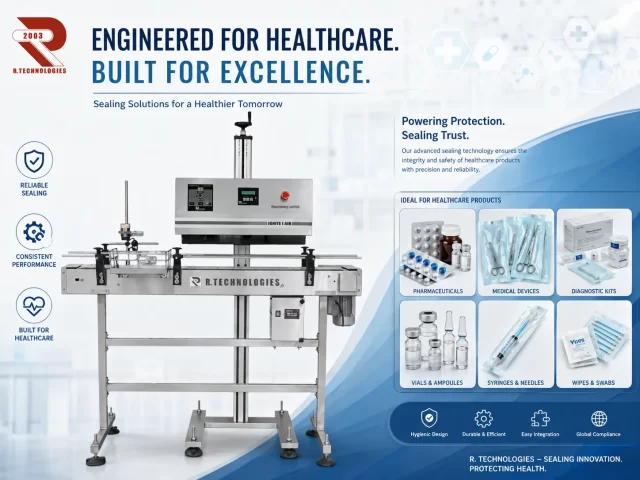 An induction cap sealing machine seals containers with an aluminum foil liner using electromagnetic induction—no physical contact required. Here’s how it works: when a capped container passes under the machine, a high-frequency electromagnetic field heats the foil inside the cap. That heat melts the liner just enough to bond it securely to the rim of the container. You end up with a tight, leak-proof seal that shows clear signs if someone tries to open it.
The whole process happens in just a split second. And because these machines can run at almost any speed, they fit right into both big pharmaceutical production lines and smaller operations working with shorter batches.
Why the Healthcare Sector Depends on Induction Sealing
Healthcare packaging isn’t just about screwing on a lid and calling it a day. Whether it’s oral medicines, vitamin syrups, antiseptics, or nutraceuticals, these products need real protection. If packages get contaminated or tampered with, patients could end up hurt, brands take a hit, and you’ve got regulators breathing down your neck. So, induction sealing matters—a lot.
Tamper Evidence and Patient Safety
In India, the Drugs and Cosmetics Act insists that drug containers get sealed so nobody can sneak them open without leaving clear signs. The US takes a similar stance with its 21 CFR Part 211.132: every OTC medicine has to include tamper-evident features. Over in the UK, both the Falsified Medicines Directive and the MHRA require tamper-resistant packaging for prescription and some OTC products. That’s where induction cap sealing machines step in for healthcare. They seal a foil barrier right across the container opening, making it impossible to remove without leaving obvious proof that someone’s been messing with it. So, if someone tampers with the package, you’ll know instantly.
Protecting Drug Potency and Shelf Life
If liquid syrups absorb moisture or vitamins get exposed to air, they break down or lose their strength—antibiotics too. That’s why induction sealing matters. It creates a tight, air-proof seal that keeps out both moisture and oxygen. This barrier doesn’t just protect the medicine inside; it keeps drugs effective for longer and helps make sure people get safe, reliable medicine all the way from the factory to the pharmacy shelf.
GMP Compliance
GMP rules aren’t just a checklist—they’re about keeping things safe and consistent, especially in healthcare. Groups like India’s CDSCO, the US FDA, and the WHO push for packaging processes that are repeatable, documented, and fully validated. With an updated induction cap sealing machine, these rules get a lot easier to follow. The machine’s digital controls track sealing power and speed, so you always know what’s going on. Stainless-steel contact parts? They’re a breeze to clean and check, making quality checks less of a headache and ensuring every batch meets the standards.
Counterfeit Medicine Prevention
Counterfeit medicines kill about one million people around the world every year. Induction-sealed packaging makes it a lot tougher for counterfeiters to tamper with medicines without leaving obvious signs. That’s why it’s such an important tool for pharmaceutical companies—and it really does help keep patients safe. If you want more details on this issue, check out the World Health Organization’s guidance on substandard and fake medicines. It’s a solid resource.
Types of Induction Cap Sealing Machines for Healthcare
Picking the right induction cap sealing machine for healthcare packaging really comes down to how much you need to produce, how automated you want things to be, and what you’re willing to spend. There are three main types to choose from.
1. Automatic Induction Cap Sealing Machine
These machines are built for fast, non-stop production lines. They hook straight into your conveyor system and do the sealing work without anyone needing to step in and help. Some models can handle up to 180 bottles every minute.
If you’re one of the big pharmaceutical manufacturers, a contract packager, or you deal with high-volume over-the-counter healthcare products, these are the way to go.
A few important features:
– Sealing heads that are either air-cooled or water-cooled to keep up with high-speed demands.
– Digital power controls so every seal is accurate and consistent.
– Stainless steel construction that meets GMP standards.
– Adjustable conveyors and sealing heads so you can handle different cap sizes.
Machines like R Technologies’ IGNITE-III AIR and IGNITE 3000 are fully automatic. They can seal caps ranging from 20 mm to 150 mm, right up to 180 bottles per minute. So if your operation is all about speed and volume, these fit the bill.
2. Semi-Automatic Induction Cap Sealing Machine
Semi-automatic machines sit right between manual and fully automatic options. They handle the sealing process for you, but you still need an operator—someone to place each bottle under the sealing head, or maybe load bottles onto a short conveyor. These machines don’t take up much space, cost less than their fully automatic counterparts, and work well if you’re running a medium-sized operation or have a bunch of different products and need to switch over often.
Who are these for? Think mid-sized pharmaceutical companies, nutraceutical manufacturers, or new healthcare businesses that are ready to move beyond sealing bottles one at a time by hand.
What should you look for in a good semi-automatic machine?
– A touch panel or digital controls for sealing time and power, so you don’t have to mess around with knobs and guesswork.
– Tool-free height adjustment, letting you swap cap sizes quickly without slowing down production.
– The ability to handle different containers — PET, HDPE, glass, you name it.
If you’re searching for something to fit these needs, the IGNITE TT 500 and IGNITE 500A from R Technologies are solid semi-automatic machines built just for this kind of work.
3. Manual Induction Cap Sealing Machine
Manual induction cap sealers are handy, portable machines. You just hold or set them on a bench and run the sealing head over a capped bottle—it’s that simple. They’re perfect for small producers, lab teams, clinics, and anyone who deals with lots of little batches and needs flexibility without a big investment.
Think pharmaceutical labs and hospital pharmacies, small healthcare brands, or even pilot production runs—these machines fit right in. R Technologies has a Manual Induction Cap Sealing Machine built for cap sizes from 20 mm up to 120 mm.
Where R Technologies Differentiates
What sets R Technologies apart? Based in Navi Mumbai and manufacturing since 2003, they’ve built their reputation on the IGNITE digital technology platform. Because of it, their sealers use fewer components, draw less energy, and keep ownership costs down. Their lineup covers everything: manual, semi-automatic, and fully automatic sealers. So as a healthcare business grows, it doesn’t have to switch suppliers—it can just stick with R Technologies. Their machines meet strict validation standards for pharma, healthcare, and personal care needs. Big names in chemicals, dairy, and pharmaceuticals already trust them.
How to Select the Right Induction Cap Sealing Machine for Your Healthcare Operation
Choosing the right induction cap sealing machine for your healthcare operation isn’t just about picking the first one that looks good. You’ve got to consider several key factors before making your decision:
First up, production speed. Check the machine’s bottles-per-minute (BPM) rating, and make sure it matches your current line speed. Give yourself a little wiggle room for future growth. If you buy a machine that’s too slow, it’ll hold everything back. Go too big and you’re just wasting money.
Next, cap and container compatibility. Look at the sealing range—minimum and maximum cap diameter. It needs to handle all your products, including those tricky child-resistant caps or anything with non-standard closures. If the machine can’t seal every cap you use, it’s not the right fit.
Now, cooling system. Air-cooled induction heads are easier to manage and require less maintenance. But if you’re running high-speed, nonstop production, water-cooled heads are better. They keep temperatures steady, which matters when you can’t afford any interruptions.
Regulatory documentation is crucial. Ask vendors for validation paperwork, GMP compliance certificates, and IQ/OQ support upfront. You’ll need these for audits—whether it’s CDSCO, WHO-GMP, or FDA. Don’t get caught scrambling after the sale.
And finally, after-sales support. In pharma, downtime doesn’t just mean slowed production—it leads to failed batches and compliance headaches. Check the supplier’s service network, spare parts availability, and their response times. If they can’t support you when things go wrong, keep looking.
Get these right, and you’ll have a sealing machine that keeps your line running smoothly and your audit stress to a minimum.
Market Outlook: Induction Sealing in Healthcare (2025–2031)
The global market for automatic induction cap sealing machines looks set to hit around USD 1.5 billion by 2033, with a steady growth rate of 6.2%. Pharmaceuticals play a huge role here. Stricter packaging rules, the growth of the generics market, and people paying more attention to product safety are pushing demand higher. In India, things look especially strong because the local pharmaceuticals industry keeps expanding and healthcare exports keep rising. All of this adds up to solid demand for newer, more advanced sealing machines.
Healthcare companies are moving toward fully automatic machines for good reason — these cut labor costs, improve consistency, and connect smoothly with smart-factory setups. So if anyone is thinking about semi-automatic systems today, they need a plan to level up to fully automatic equipment in the near future.