
If you make products in India—pharma, food and beverages, dairy, agro chemicals, personal care—you know product integrity starts with the cap. One unsealed bottle out there, and customers start doubting everything. Trust, gone. That’s why induction cap sealing machines are pretty much essential now.
Let’s break down how these machines work, step by step—how they actually seal, what happens inside the process, and why so many Indian manufacturers are switching to modern air-cooled models like IGNITE-I AIR from R Technologies for efficient, tamper-evident packaging.
What’s an Induction Cap Sealing Machine?
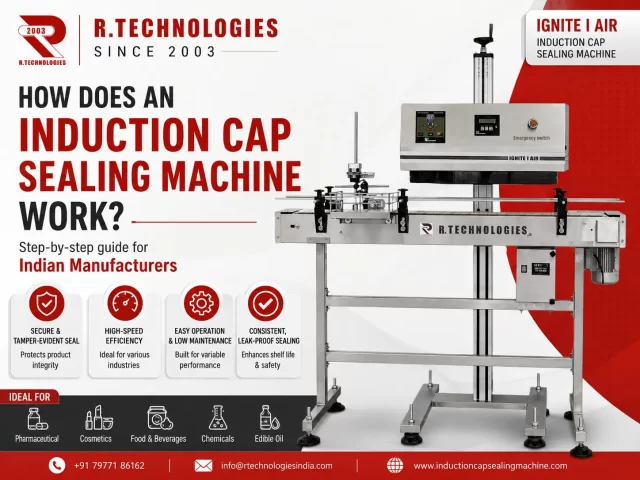 This is a clever device that uses electromagnetic induction to bond a foil liner to the mouth of your container—plastic or glass—without touching the bottle or cap directly. You get a tight, tamper-evident seal that keeps product safe from leaks, contamination, and shady tampering.
Induction sealing doesn’t blast the container with heat or slather it in glue. That’s a win: it’s cleaner, faster, and uses less energy, which is what busy production lines in India need.
So, How Does Induction Sealing Actually Work?
It’s all physics. The machine has an induction coil that creates a high-frequency electromagnetic field. When your bottle—with its specially lined cap—rolls beneath this field, the aluminium foil inside the cap gets hot fast. Why? Eddy currents. That heat melts the polymer bonding layer on the foil, which sticks itself to the rim of the container. Once the bottle leaves the field, the polymer cools and locks everything together—airtight seal, done, in a flash.
No direct heat. No touch. Just the right science.
Running Through the Process—Step by Step
Step-by-Step: How an Induction Cap Sealing Machine Works
-
Cap Liner Prep
It starts before the bottle meets the machine. Your caps need a multi-layer induction seal liner: foam or pulp backing (stays in cap after sealing), wax (temporary bond), aluminium foil (heats up), and a heat-seal polymer film (bonds to the bottle). Good cap suppliers already include these liners. It’s standard stuff, and Packaging Industry Association of India (PIAI) can help you find the right ones.
-
Capping
Once filled, bottles head to the capping station. Tighten the cap properly—by hand, semi-auto, or machine. Uneven or loose caps? That’ll lead to failed seals. If you’re running high-speed lines, automatic capping units make sure every cap is snug.
-
Conveyor into Induction Zone
Bottles move on a belt into the sealing tunnel or under the sealing head (depends on the machine). In machines like IGNITE-I AIR, bottles pass under the induction head at speeds up to 55 feet per minute. Conveyor speed and power output are matched. Too fast? Foil doesn’t heat enough. Too slow? You could melt or damage the cap.
-
Induction Field Generation
As bottles enter the seal zone, the generator kicks in, energizing the induction coil. The electromagnetic field goes straight through the cap and zeroes in on the foil. The foil heats up quick and melts the polymer. Newer models, like IGNITE digital from R Technologies, use fewer parts and give tighter power control. That means less energy waste, steady sealing, and lower running costs.
-
Polymer Bonding—Getting That Seal
As the polymer melts, it bonds tight to the rim of the container—HDPE, PET, PP, glass, whatever. At the same time, the wax between foil and backer melts, so when the customer opens the bottle, the backer separates cleanly and leaves the foil sealing the bottle. This all happens in milliseconds. Hundreds—even thousands—of bottles get sealed every hour.
-
Cooling and Seal Locking
No water cooling here. Bottles leave the field and cool down naturally—the polymer solidifies in seconds. IGNITE-I AIR uses a compact air-cooled system for the generator and coil head—so no water supply or plumbing hassles. That’s a big plus, especially for smaller manufacturers needing a plug-and-play solution.
-
Seal Inspection and Quality Control
Sealed bottles roll into inspection. Inline detectors catch missing liners, loose or misaligned caps, jammed bottles—you name it. Some machines, like IGNITE-I AIR, offer these as add-ons:
- Missing foil detectors
- Cross cap or loose cap sensors
- Reject mechanisms that automatically remove bad bottles
- Jam detectors, lights, and alarms
For pharma or food, these quality features are mandatory for GMP compliance.
-
Downstream Handling
Bottles that pass inspection move on for labelling, batch coding, packaging, or dispatch. The sealed foil now acts as a visible tamper barrier—anyone tries to mess with it, you’ll see it right away.
Why IGNITE-I AIR Makes Sense for Indian Manufacturers
The IGNITE-I AIR from R Technologies (Navi Mumbai) was designed with Indian shops in mind. Here’s what it brings:
- Standard Indian power (200–240V)
- 1 kW output: handles most production speeds
- Universal coil for cap sizes from 20mm to 160mm (switch sizes with no coil changes)
- 55 feet/minute line speed
- Air-cooled (no water needed, easier maintenance)
- 60 kg—easy to move around
- Smart digital controls, alarms, and indicator panel
That universal coil means you can run multiple SKUs back to back, no downtime swapping coils.
Who Uses Induction Cap Sealing Machines?
These aren’t industry specific—they’re everywhere:
- Pharmaceuticals: needed for tamper-evidence compliance
- Food & Beverages: sauces, oils, juices, dairy
- Cosmetics & Personal Care: shampoos, lotions, serums
- Agro and Petro Chemicals: hazardous liquids
- – Water & Dairy: high-speed, hygiene-focused lines
- Automotive: lubricants, coolants, fluids
What Problems Does Induction Sealing Solve?
Still doing manual foil application or liner-less caps? That usually leads to:
- Leaks during road transit
- Tampering and loss in pharma or FMCG
- Contamination from humidity and air
- Rejection and recall headaches with distributors
Induction sealing gets rid of all these issues—in one easy step, without slowing down your production.
Picking the Right Cap Sealing Machine—What to Look For
Think about:
- Line speed: match your production pace
- Cap size range: make sure the coil fits all your bottle caps
- Cooling system: air-cooled wins if your floor’s dusty or tight on space
- Power requirements: check your facility’s specs
- Accessories: consider detectors and rejectors, especially for pharma
- – After-sales support: pick a manufacturer with local service
R Technologies (MIDC Turbhe, Navi Mumbai) offers everything from handheld units to fully automatic machines, with after-sales support across India.
FAQs
Can one machine seal different cap sizes?
Absolutely. IGNITE-I AIR’s universal coil covers 20mm to 160mm caps with zero coil changes.
Can induction sealing work on glass bottles?
Yes, it works on glass, HDPE, PET, PP—any rigid container, as long as it has the right liner.
How do I know if the seal is good?
Look for a flat, smooth, wrinkle-free seal that sticks evenly to the bottle mouth. Inline accessories can inspect each bottle for you.
Does the machine need water for cooling?
Nope. IGNITE-I AIR is air-cooled, no plumbing required.
What’s the typical ROI?
Most mid-volume operations recover the investment in 12–24 months through fewer leaks, less rejection, and lower tamper claims. Ask R Technologies for numbers tailored to your business.
Bottom Line
Induction cap sealing machines are a smart move for Indian manufacturers. They lock in tamper-evident, airtight seals at speed—no water, minimal energy, low hassle. From getting the liners ready, through electromagnetic bonding, to final inspection, everything runs reliably and repeatably.
If you’re after a compact, efficient system, IGNITE-I AIR from R Technologies is a solid pick. Local manufacturing, service, and proven performance in pharma, FMCG, dairy, chemicals—you name it.
Ready to get started? Call R Technologies at +91 98204 91182 or check out inductioncapsealingmachine.com for a demo or quote.